

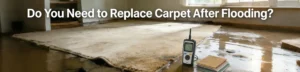




Flooded carpet creates one of the most stressful home recovery decisions:
Should you dry it — or replace it?
The answer isn’t always obvious. Carpet can sometimes look salvageable while hiding serious problems underneath. Other times, it may seem ruined but can actually be restored with the right equipment.
Quick Decision Summary
Situation | Can You Save It? | Recommended Action |
Clean water, <24 hrs | Often yes | Dry aggressively |
Clean water, 24–48 hrs | Maybe | Inspect padding carefully |
Wet >48 hrs | Very unlikely | Replacement recommended |
Gray water (appliance overflow) | Rarely | Replace padding minimum |
Black water (sewage/flood) | No | Full replacement required |
Tip: Aggressive drying only works if you act fast and use the right equipment. See Best Dehumidifier Size for Wet Carpet.
Step 1: Identify the Type of Flood Water
Category 1 – Clean Water
- Source: Burst pipes, appliance leaks, rainwater
- Risk: Low if addressed quickly
- Salvage Potential: High if drying starts within 24 hours
Category 2 – Gray Water
- Source: Washing machine overflow, dishwasher leaks, toilet overflow (no feces)
- Risk: Moderate — may contain contaminants
- Salvage Potential: Moderate to Low; padding usually must be replaced
Category 3 – Black Water
- Source: Sewage backup, river flooding, standing water with bacteria
- Risk: Severe — contains pathogens
- Salvage Potential: Zero — replacement required
The IICRC recommends replacing any porous material exposed to black water. Carpet and padding cannot be adequately sanitized.

Step 2: How Long Has the Carpet Been Wet?
Time Wet | Salvage Potential | Risk Level |
<24 hrs | High (if dried properly) | Low |
24–48 hrs | Moderate — depends on conditions | Medium |
48 hrs | Low — replacement likely | High |
72 hrs | Very low — mold probable | Severe |
Even if the surface feels dry, padding may remain wet underneath, creating mold risk.
See How Long Does Carpet Take to Dry with a Dehumidifier for detailed drying timelines.
Step 3: Check Carpet Padding
Carpet fibers often dry quickly, but padding is the weak link:
Material | Absorption | Drying Difficulty |
Nylon/Polyester | Low–Moderate | Moderate |
Wool | High | Difficult |
Standard Padding | Very High | Often must be replaced |
Why padding matters:
- Traps moisture against subfloor
- Wicks water back into carpet fibers
- Promotes mold growth
- Causes musty odors
If padding is soaked, replacement is usually necessary — even if the carpet itself can be saved.

Step 4: Smell and Visual Inspection
Smell Test
Smell | What It Means | Verdict |
No odor | Drying successful | Good |
Musty, earthy | Moisture trapped — mold may be starting | Investigate |
Strong, foul | Bacteria/mold present | Replace likely |
Sewage | Black water contamination | Replace immediately |
Visual Red Flags
- Mold spots on carpet or padding
- Brownish staining
- Padding crumbling or separating
- Subfloor warping
- Delaminated carpet fibers
If you see these, replacement is the safest choice.
Step 5: Quick Decision Rule
Replace immediately if:
- ❌ Black water (sewage/flood)
- ❌ Wet for more than 48 hours
- ❌ Visible mold or strong musty odor
- ❌ Padding is saturated and can’t be removed separately
Restoration may work if:
- ✅ Clean water source
- ✅ Wet for less than 24 hours
- ✅ Padding is dry or removable
- ✅ You have proper drying equipment (fans + high-capacity dehumidifier)
Still unsure? Lift a corner of carpet and check the padding. If it feels damp or smells musty, replacement is the safer choice.
Step 6: How to Attempt Carpet Restoration
1. Extract Standing Water
Use a wet-dry vacuum or professional water extractor
2. Remove Padding (If Necessary)
- Cut into sections and dispose
- Allows airflow to subfloor
3. Create Airflow
- High-velocity fans across carpet
- Lift carpet edges for airflow underneath
- Position fans in opposite corners
4. Dehumidify Aggressively
- Use a properly sized dehumidifier
- Keep RH below 50%
- For flooding, commercial SLGR units are recommended
5. Monitor Moisture Levels
- Use a hygrometer
- Check underneath carpet periodically
- Continue drying 24 hours after surface feels dry
6. Disinfect (If Gray Water)
Apply antimicrobial solution after drying
Step 7: When to Call a Professional
Consider professional restoration if:
- Large areas affected (>1 room)
- Black water contamination
- Carpet wet >48 hours
- Suspected subfloor damage
- Visible mold or strong odor
- Lack of high-capacity drying equipment
Professionals use moisture meters, commercial dehumidifiers, multiple air movers, and infrared inspection.
Step 8: Cost Considerations
Factor | Restoration | Replacement |
Equipment | $100–500 | $0 |
Professional labor | $500–2,000+ | $0 |
New carpet | $0 | $2–10 / sq ft installed |
Padding | $0.50–1.50 / sq ft | Same |
Time | 3–7 days | 1–2 days |
Mold risk | Low if done correctly | None |
Costs vary by region, carpet quality, and equipment rental vs purchase.
Older or low-quality carpet may be more cost-effective to replace.
Step 9: Special Case – Basement Floods
Basements present unique challenges:
- Cooler air slows evaporation
- Concrete subfloor traps moisture
- Higher RH increases mold risk
Tips:
- Check vapor barriers
- Concrete may need weeks to fully dry
- Commercial SLGR dehumidifiers outperform small residential units
- Consider a basement dehumidifier system for long-term moisture control
Full carpet/padding replacement is often safest if water sits longer than 24 hours.
Step 10: Final Checklist – Replace or Restore
Replace Immediately If:
❌ Contaminated water (gray/black)
❌ Wet >48 hours
❌ Mold or strong odor
❌ Saturated padding that can’t be removed
❌ Subfloor damage
Consider Restoration If:
✅ Clean water
✅ Drying started <24 hours
✅ Minimal padding moisture
✅ No visible mold or odor
✅ Proper equipment available (commercial dehumidifier + fans)
Rule of thumb: When in doubt, inspect a small section of padding. If wet, smelly, or discolored → replace.
Need Equipment?
Choose the right dehumidifier for your situation:
- For small leaks: 30-50 pint portable units
- For moderate water damage: 50-70 pint high-capacity units
- For flooded rooms: 90+ pint commercial SLGR units
Not sure which one? See our [complete dehumidifier buying guide].
Related Resources
- How Long Does Carpet Take to Dry with a Dehumidifier?
- Will Wet Carpet Mold?
- Can a Dehumidifier Dry Wet Carpet?
- Best Dehumidifier Size for Wet Carpet
- Carpet & Contents Drying Solutions
Frequently Asked Questions
Can carpet be saved after sewage backup?
No. Black water contamination requires full replacement for health safety.
How do I know if padding is wet?
Press a paper towel into the carpet base overnight. If damp in the morning, padding is wet.
Is it safe to dry carpet myself?
For clean water and small areas, yes — with proper equipment. For large areas or contaminated water, call a professional.
Does homeowners insurance cover carpet replacement?
Often yes for sudden events like burst pipes, but may exclude flooding. Check your policy.
Bottom Line
You don’t always need to replace carpet after flooding — but timing, water type, and padding saturation are critical.
The real question isn’t “Can it be dried?”
It’s: Can it be dried completely and safely before mold develops?
If aggressive drying isn’t possible, replacement is the safer, long-term choice — protecting your health, indoor air quality, and home investment.
